The manuscripts, objects, data and drawing decisions behind Spatial Press.
Historical sources, reconstructed objects and finished editions are different things. This page identifies those sources, explains our adaptations and keeps the unresolved parts visible. It is a selected register, not a complete rights clearance or a certificate of scientific accuracy.
Named museums, artists, scientists and agencies are sources, not sponsors or endorsers of Spatial Press.
Manuscripts & images
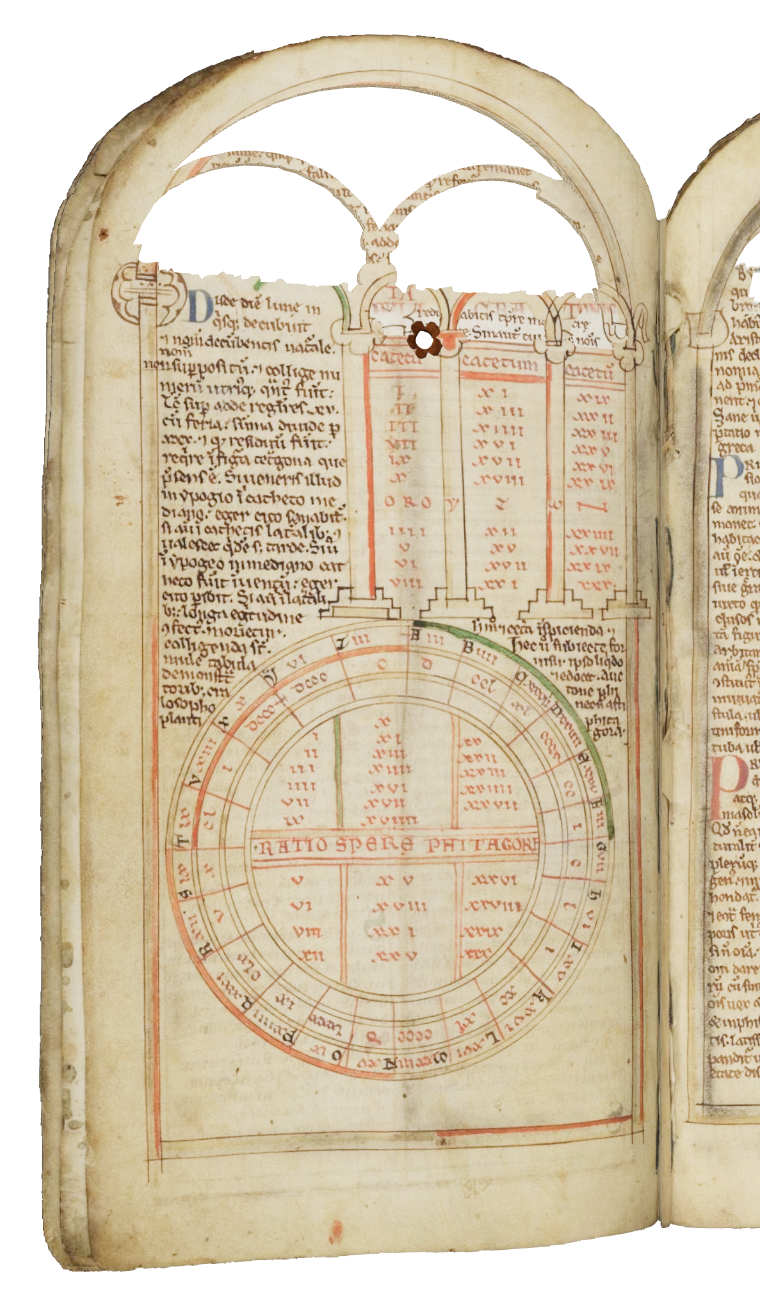
MS Arabic 862
Wellcome Collection, MS Arabic 862. The collection record identifies a paper manuscript of assorted texts on geomancy and astronomy and marks its digitized imagery Public Domain Mark. The book geometry, page registration, movement and contemporary English text are Spatial Press adaptations.
Wellcome Collection, MS.21, digitization b20927976. The archived source record identifies the imagery with the Public Domain Mark. Page geometry, masks, assembly and interface registration are contemporary adaptations, not unmodified catalog photographs.
Inspect the reconstructed folio. This separate art-only view documents presentation; it is not a chart calculation, complete rights clearance or a print-production master.
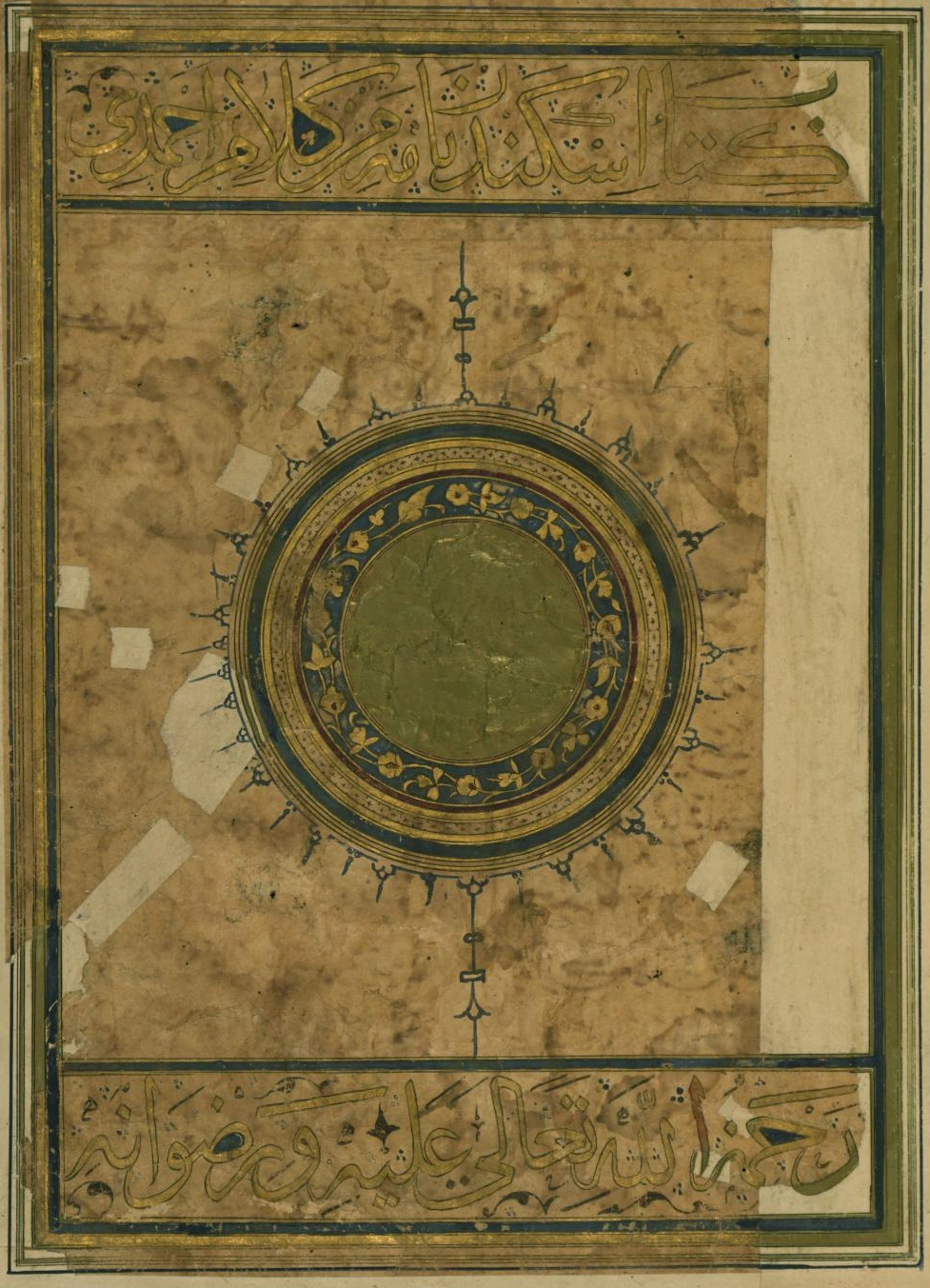
Ottoman title page · 1486
Walters Art Museum W.664.2A, an illuminated title page from the manuscript of Ahmedi’s work, dated 891 AH / 1486. The museum credits scribe Kamal ibn ʿAbd Allah al-Qaramani and marks its image CC0. The studio crop and color-matched display are derivatives.
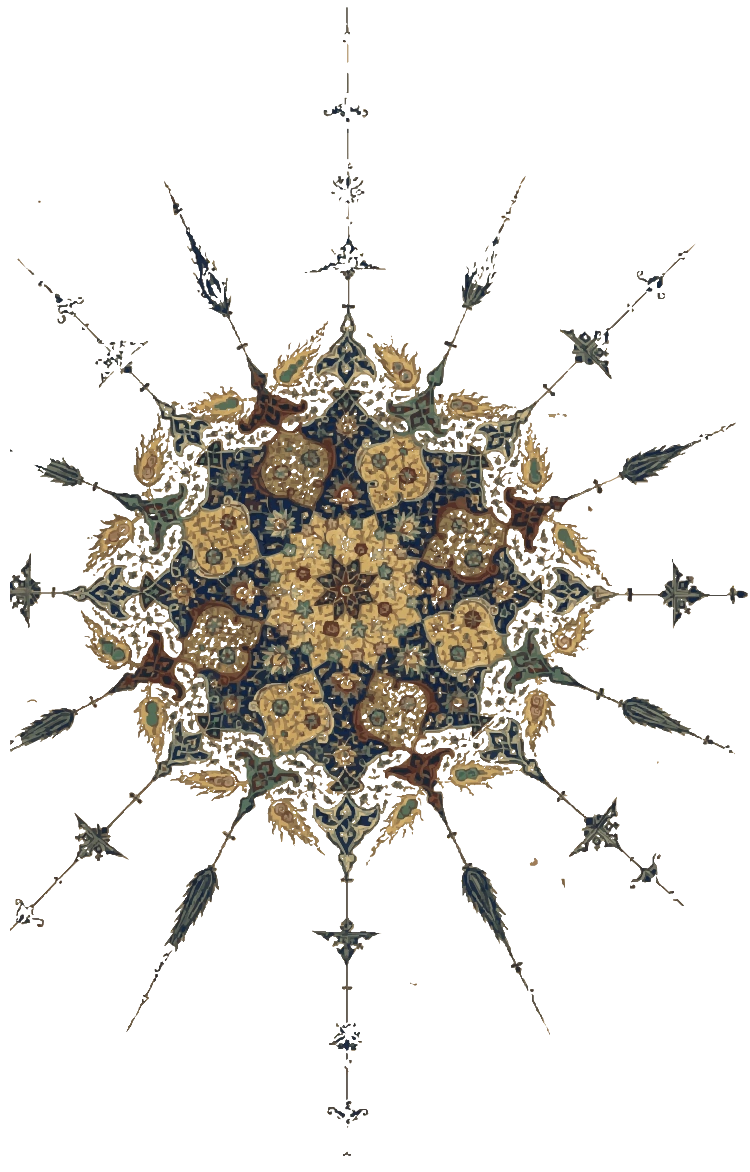
Walters Art Museum W.624.42A, from the Khamsa of Amir Khusraw Dihlavi, dated 1597–1598. The museum ascribes the illumination to Husayn Naqqash and marks its image CC0. This studio-toned display and any traced SVG masters are derivatives, not museum facsimiles.
The North, East, South and West ornamental letters come from Jeremias Falck's engraved alphabet after Johann Christian Bierpfaf, c. 1645–1650. They were not originally compass symbols. Their use as observer-frame directions is ours.
The repository keeps per-letter source manifests, human masks and vector checksums. Archive presence and publication approval are separate gates.
Bayer and the charting tradition
Johann Bayer's Uranometria (1603) is a historical visual and nomenclatural reference for constellation research. Its plate evidence, star identification and modern catalog mapping must be traced separately. A 1603 title is not a blanket license for every modern scan.
Other workroom materials, including planetary textures, Jahangir zodiac-coin studies and historical wheel components, are registered and reviewed individually rather than automatically declared cleared for every edition.
Presentation objects & interface
Coming soon, in motion
The approved phone composition uses the feather and copper nib credited below, plus Brass Key from Common Quest Keys by Clint Bellanger, adapted under CC BY 4.0: isolated, normalized, given a warm-brass material, placed and animated. The brass kontusz knob from Virtual Museums of Małopolska is CC0; its original textures and material are retained, with adapted scale, placement and motion.
The screen is a synthetic demonstration, labelled Coming soon. The creators do not endorse these adaptations.
These three models are adapted under CC BY 4.0. Changes include isolation, scaling, placement and animation; seven material replacements on the compass; and a natural feather-and-nib composition with a copper replacement material for the nib. The square composition also uses Set Square GN017 by Field Ready / Tom van der Vaart (2018), original CAD, licensed CC BY 4.0; adapted with satin-brass and navy materials, placement and animation. The creators do not endorse these adaptations. Asset credits and adaptation record.
The stereoscope by A. Mattey, 1905–1920 is from the Smithsonian National Museum of African American History and Culture, Gift of Alan Laird, object 2017.111.16. The Smithsonian identifies its 3D media as public domain. Our presentation adapts object scale, placement, lighting and animation; these arrangements are not historical reconstructions of the objects together.
The square hero’s replacement seal relief is reconstructed from the Aries coin photographs in Berlin, Münzkabinett der Staatlichen Museen, 18248181, photographs by Reinhard Saczewski. The museum licenses those image files with Public Domain Mark 1.0. The traced and extruded relief is our adaptation, not a museum-supplied 3D scan.
The preserved 10 October source manifest records these scans as Public Domain Mark. The earlier Wikimedia copies were shared under CC BY 4.0. We credit Wellcome Collection. Adaptations: exact source crops, one right-angle rotation, exterior-paper masks, small WebP derivatives and responsive border spacing. For those archived derivatives, the historical linework was not redrawn and modern labels were separate interface text. Source images, checksums and crop record.
The current controls have changed. This credit remains with the archived pharmacy-label assets; it does not identify or license every current button.
Current cartouche buttons
The current site uses separately prepared button artwork and baked lettering. The pharmacy-label credits above must not be transferred to those files. Item-level source and rights documentation for the new button set still needs to be reconciled here.
Sky, place & time
These records have different roles. A research source or independent comparator is not automatically the data used by every live product.
Place names, feature IDs and reference coordinates; local searchable indexes. GeoNames data are credited under CC BY 4.0. Place identity is not proof of the exact historic standing point.
Versioned civil-time rules, including historical offsets and repeated or missing clock times. Local time and an astronomical instant must not be conflated.
Ephemeris kernels and planetary frames; ANGIE science work includes a checksum-gated DE442s research lane. A validated kernel is not proof that every surface pose is publication-ready.
Earth orientation, polar motion and UT1 for supported epochs; snapshot and time-scale coverage matter. Missing historical coverage cannot quietly become zero correction.
Astrometric reference catalog, identifiers and modern stellar evidence; cite Gaia Collaboration and DPAC. Do not claim every decorative background star is an exact Gaia chart placement.
The historical source reference for the website’s separate decorative star field. The current background repeats its packed star field in display layers. Brightness, color and repeated placement are design choices, not an observer-specific scientific chart. Exact byte parity with the earlier deployed catalog has not been established.
Earth-satellite orbit elements and propagation research; ISS, Hubble and other spacecraft require object-specific evidence. Orbit placement does not prove a historical station configuration, attitude or solar-array pose.
This is a separate projected display asset, not the same catalog or use as every chart or the website background.
A correct orbital position does not by itself establish a historically correct spacecraft pose or a registered surface orientation. Missing evidence remains missing.
Making the image & keeping the evidence
ANGIE is the computational environment; Spatial Press is the publishing practice. The work separates calculated geometry and physical state from projection, legibility, material and color choices. Moving a label or enlarging a body must not silently change its calculated direction.
“Witnessed sky” means a reconstruction for a stated observer, place and instant, within documented limits. It does not mean every enlarged body was visible to the unaided eye, or that a stylized edition is a photograph.
Input: date, time, place, coordinate origin and timezone evidence, including ambiguous or unavailable values.
Calculation: resolved time scale, ephemeris, observer frame, positions and named conventions.
Adaptation: source-object IDs, images, masks, geometry, registration and drawing transforms.
Edition: renderer revision, output specification, notices and known omissions.
A useful receipt records those inputs and versions alongside licenses, transformations and exceptions. This is the standard being built toward; not every field is promised with every customer download.
These are citation anchors and implementation witnesses, not a claim that every reference runs in the public browser.
Research literature
Gaia Collaboration et al. (2016). “The Gaia mission.” Astronomy & Astrophysics 595, A1. DOI ↗
Gaia Collaboration et al. (2023). “Gaia Data Release 3: Summary of the contents and survey properties.” Astronomy & Astrophysics 674, A1. DOI ↗
Charles H. Acton, Jr. (1996). “Ancillary data services of NASA's Navigation and Ancillary Information Facility.” Planetary and Space Science 44(1), 65–70. DOI ↗
Within the ANGIE project, the fresh/science/ audit, fresh/observer/ resolution boundaries, fresh/canvas/ rendering, website/ presentation, book/ registration, and assets/cardinals/ human mask archive carry different responsibilities. A source citation names a dependency; it does not transfer authorship of our composition to its author or of their data to us.
Repository file paths describe technical evidence, not publicly accessible source-code downloads. Internal checksums, validations and incomplete integration notices remain part of the working research archive.
Rights, limits & corrections
Source credits are not blanket permission for every derivative. Public access, public-domain status, CC0 and attribution licenses have different meanings. Collection identifiers and the terms attached to the particular source file should follow it into any edition.
Reconstruction geometry, registration, code, edited masks, material choices, page design and explanatory copy are contemporary work, subject to the rights in their sources. The historical manuscripts were not made by Spatial Press.
Open items: the RCAF tag photography permission remains pending; the current cartouche-button source record needs reconciliation; historical scans, planetary textures and other workroom studies are reviewed asset by asset. Archive presence does not establish commercial clearance or publication approval.
Digital and printed editions charge for computation, artwork, publishing and applicable fulfillment—not ownership of public-domain imagery or scientific facts. Prices and product specifications are those stated by the live purchase flow, not an old planning target.
Wellcome’s manuscript source designation is Public Domain Mark; the two Walters image records use CC0. The distinct source and adaptation notes above remain applicable.
Reading copy updated . This is a selected source register; unresolved evidence is not filled in by inference.